
Which Electric Motorcycle Motors Are Better for Cargo Three-Wheel Vehicles?
The last mile of urban logistics is increasingly served by cargo three-wheel vehicles. They carry parcels, food, building materials, and agricultural produce through streets that are too narrow for vans and too busy for large trucks. The duty cycle is punishing. A loaded cargo trike may start and stop two hundred times a day, climb ramps and bridge approaches at full weight, and operate in heat, rain, and dust. The electric motorcycle motors inside these vehicles are therefore not chosen on peak power alone. They are chosen on low-speed torque, thermal endurance, ingress protection, controller compatibility, and the supplier's ability to prove these properties with data. A motor that performs well on a flat test track can fail in a delivery fleet within one season if the specification does not match the real duty.
This article is written for buyers who source Electric Motorcycle Motors for cargo three-wheel vehicle programs. It compares the main motor topologies, explains why low-speed torque matters more than a headline power number, examines thermal and ingress protection, discusses voltage platform and controller matching, and provides a supplier audit framework. The recommendations are drawn from the production and field experience of Ningbo Qianjiang Motor Co., Ltd., where our factory builds electric motorcycle motors for light electric vehicles and cargo trikes. The goal is to help procurement teams ask better questions, compare suppliers on verifiable data, and select a motor that keeps the fleet moving.
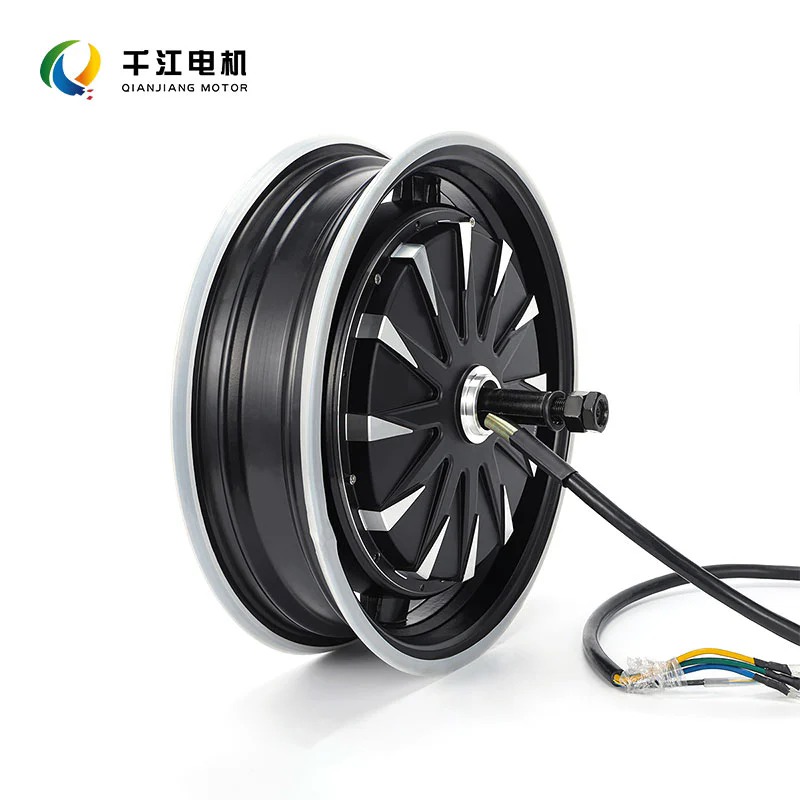
Table of Contents
- What Motor Topologies Suit Cargo Three-Wheel Vehicles?
- Why Does Low-Speed Torque Matter More Than Peak Power?
- How Do Thermal Management and Ingress Protection Affect Fleet Uptime?
- What Voltage Platform and Controller Matching Reduce Total Cost?
- How Should Buyers Audit a Motor Supplier Before Fleet Rollout?
- Conclusion
- Frequently Asked Questions
What Motor Topologies Suit Cargo Three-Wheel Vehicles?
The first procurement decision is topology. Cargo three-wheel vehicles commonly use one of three arrangements. A mid-drive permanent magnet synchronous motor drives the rear axle through a reduction gearbox or a differential. A direct-drive hub motor is built into the rear wheel and eliminates the gearbox. A geared hub motor uses an internal planetary reduction inside the wheel hub. Each arrangement has a different effect on torque delivery, unsprung mass, cooling, maintenance, and cost. The comparison below is written for a buyer who must match the topology to a route profile, not to a brochure claim.
| Parameter | Mid-Drive PMSM with Reduction | Direct-Drive Hub Motor | Geared Hub Motor |
| Typical continuous power | 3 kW to 10 kW | 2 kW to 6 kW | 1 kW to 4 kW |
| Low-speed wheel torque | High, through gear reduction | Moderate, limited by wheel diameter | High for its size, through internal reduction |
| Unsprung mass | Low, motor is frame mounted | High, motor is in the wheel | Moderate, gearset adds mass |
| Cooling access | Good, air or liquid cooling is practical | Limited, heat is trapped in the wheel | Limited, gearbox heat adds to motor heat |
| Maintenance | Belt, chain, or gearbox service | Bearings and seals only | Gear oil and gear wear |
| Best route profile | Hilly, heavy, stop-start, high daily distance | Flat, light, short distance | Moderate hills, light cargo |
For a cargo three-wheel vehicle that carries 500 kg or more and operates on routes with ramps, bridge approaches, or unpaved sections, the mid-drive topology is usually the better choice. The reduction gearbox multiplies motor torque before it reaches the wheel, so the motor can operate at a comfortable speed while the wheel receives the torque needed to start and climb. The motor is also mounted on the frame, which gives the engineering team access for cooling and service. Direct-drive hub motors are attractive on flat routes because they remove the gearbox and reduce maintenance points, but the torque available at the wheel is limited by the wheel radius and the motor diameter. Geared hub motors sit between the two, offering more torque than a direct-drive hub in a compact package, but the internal gearset adds heat and wear that must be managed.
The purchasing short list for topology should include four checks. First, confirm the continuous power rating at the expected ambient temperature, not at a laboratory baseline. Second, confirm the wheel torque at the lowest operating speed, because this is what moves the load from rest. Third, confirm the motor mounting and suspension interface, because unsprung mass affects tire wear and ride quality. Fourth, confirm that the topology is supported by the controller and the battery platform. Our engineering team reviews these four checks with buyers before a sample is ordered, because a topology that is wrong for the route will not be fixed by a controller setting.
Electric Motorcycle Motors for cargo trikes are often judged on peak power in a sales meeting. That number is misleading. A 6 kW peak motor may deliver only 2 kW continuously, and a cargo trike may need continuous power for hours. The topology decision should be based on the continuous rating, the duty cycle, and the route profile. Our test data from cargo trike programs shows that mid-drive systems with a properly matched reduction ratio deliver lower motor temperature and longer service life than direct-drive hubs on the same hilly route, even when the hub motor has a higher peak rating. The lesson for procurement is simple: compare continuous performance, not peak claims.
At the end of the topology review, the buyer should have a clear answer to one question. Does the route require wheel torque at low speed for more than a small fraction of the shift? If yes, a mid-drive PMSM with a reduction gearbox is the lower-risk choice. If the route is flat and the cargo is light, a direct-drive or geared hub may reduce maintenance and cost. Qianjiang Motor supplies both topologies, so the recommendation is based on the duty, not on a preference for one product family.
Why Does Low-Speed Torque Matter More Than Peak Power?
A loaded cargo three-wheel vehicle spends much of its life at low speed. It pulls away from a loading dock, climbs a ramp into a warehouse, threads through a market, and stops again. The motor must produce enough wheel torque to accelerate the mass from rest and to hold speed on a grade. Peak power is a measure of how much work the motor can do at high speed. It does not tell the buyer whether the vehicle can start on a hill without overheating the controller or slipping the clutch in a geared system. Low-speed torque is the parameter that determines whether the route is feasible.
The relationship is straightforward. Wheel torque is the product of motor torque, the reduction ratio, and the drivetrain efficiency. If a mid-drive motor produces 20 Nm at the shaft and the reduction ratio is 8 to 1, the wheel torque before efficiency loss is 160 Nm. If the same vehicle uses a direct-drive hub with no reduction, the wheel torque is the motor torque itself, limited by the motor diameter and the wheel radius. The difference explains why a mid-drive system can start a heavier load on a steeper grade with a smaller motor. The calculation below shows how a buyer can compare two options before a sample is built.
- Estimate the total mass: vehicle, driver, cargo, and fluids. For a cargo trike, use the gross vehicle weight, not the empty weight.
- Estimate the grade: measure the steepest ramp on the route as a percentage. A 10 percent grade is a rise of 1 meter over 10 meters of travel.
- Calculate the grade force: mass times gravity times grade percentage. Use 9.81 for gravity and keep the result in newtons.
- Calculate the required wheel torque: grade force times wheel radius. Add a margin for rolling resistance and acceleration.
- Divide the required wheel torque by the reduction ratio and drivetrain efficiency to obtain the required motor torque.
- Compare the required motor torque with the continuous torque rating of the candidate motor at the expected temperature.
This calculation often reveals that a motor with a lower peak power but a higher continuous torque and a suitable reduction ratio is the better choice. A 4 kW mid-drive motor with a well-matched gearbox can outperform a 6 kW direct-drive hub on a 12 percent ramp because the gearbox multiplies torque and the motor stays within its thermal limit. The buyer should ask the supplier for the continuous torque curve, not just the peak torque number. The continuous curve shows the torque the motor can deliver indefinitely at a given speed and temperature. The peak curve shows what it can deliver for a few seconds. Cargo trikes need the continuous curve.
The controller also plays a role. A controller with a current limit that is too low will prevent the motor from reaching its torque potential. A controller with a current limit that is too high will overheat the motor on long grades. The correct match is a controller whose current limit is set to the motor's continuous current rating, with a short-term boost that is coordinated with the motor's thermal time constant. Our field data from cargo routes shows that controller current limits set above the motor's continuous rating are a common cause of stator overheating and insulation failure. The buyer should confirm that the controller and motor are matched as a system, not purchased as separate commodities.
For a procurement team, the low-speed torque review should produce three documents. The first is a route profile with the steepest grade and the typical load. The second is a torque calculation showing the required wheel torque and the required motor torque. The third is the supplier's continuous torque curve at the expected ambient temperature. If the supplier cannot provide the third document, the first two are not enough to qualify the motor. Electric Motorcycle Motors for cargo applications are system components, and the torque data is the basis for the system match.
How Do Thermal Management and Ingress Protection Affect Fleet Uptime?
Thermal management and ingress protection are the two specifications that separate a motor that survives a fleet season from a motor that returns to the workshop. A cargo trike motor may run for eight hours a day at 60 to 80 percent of its continuous rating. The losses in the stator and the rotor produce heat, and that heat must be removed. If the motor is air cooled, the airflow path must be clear and the ambient temperature must be within the design limit. If the motor is liquid cooled, the coolant circuit must be maintained and the radiator must be sized for the duty. If the motor is enclosed in a wheel hub, the heat has nowhere to go except through the hub and the rim. The table below summarizes the thermal and ingress parameters that buyers should require in a datasheet.
| Parameter | Typical Requirement for Cargo Trikes | Why It Matters |
| Continuous power at 40 deg C ambient | At least 70 percent of the rated continuous power | Prevents derating surprises in hot climates |
| Insulation class | Class F or Class H | Provides thermal margin for stator windings |
| Cooling method | Air cooling with a defined airflow path, or liquid cooling | Determines the continuous duty capability |
| Ingress protection | IP54 minimum, IP67 for exposed wheel hubs | Protects against dust and water splash |
| Bearing protection | Sealed bearings with a defined service interval | Prevents water and dust ingress through the shaft |
| Thermal sensor | Stator temperature sensor with controller input | Enables derating before damage occurs |
Ingress protection is not a single number that guarantees durability. An IP54 motor can still fail if the cable entry is not sealed, if the breather is positioned where water collects, or if the connector is not rated for the same environment. The buyer should ask for the ingress test report, not just the IP rating. The report should show the test setup, the duration, and the result for the complete motor assembly, including the connectors and the cable gland. A motor that passes the IP test as a bare unit but fails with the connector installed is not a reliable motor for a fleet.
Thermal management also includes the controller and the battery. A motor with a high continuous rating can be limited by a controller that overheats or a battery that cannot deliver the current. The buyer should require a system thermal test that runs the motor, controller, and battery together at the expected ambient temperature and duty cycle. The test should record the stator temperature, the controller temperature, and the battery temperature over time. If any component reaches its limit before the end of the duty cycle, the system is not matched. Our thermal test reports for cargo trike systems include these three temperatures, and the reports are used to set the controller derating profile before delivery.
Fleet uptime is the business outcome of these specifications. A motor that derates early on a hot afternoon will slow the route and reduce daily deliveries. A motor that ingests water through the connector will fail in the rainy season. A motor that lacks a stator temperature sensor will run to failure instead of derating gracefully. The procurement decision should therefore include the thermal and ingress data as mandatory acceptance criteria. Electric Motorcycle Motors for cargo trikes are exposed to the same weather as the vehicle, and the datasheet should reflect that reality.
Ningbo Qianjiang Motor Co., Ltd. provides thermal test reports and ingress test reports for the motors supplied to cargo trike programs. Our factory treats these reports as part of the product specification, not as optional marketing material. The buyer can review the test conditions and compare them with the route profile before approving the motor. This is the level of evidence that a fleet procurement team should expect.
What Voltage Platform and Controller Matching Reduce Total Cost?
The voltage platform determines the current for a given power level, and the current determines the cable size, the connector size, the controller rating, and the losses. A 48 V platform is common on light cargo trikes, but it requires high current for a 6 kW motor. A 72 V platform reduces the current by one third for the same power, which allows smaller cables and a smaller controller. A 96 V platform reduces the current further, but it introduces higher voltage safety requirements and a more expensive battery management system. The table below compares the platforms for a 6 kW continuous cargo trike motor.
| Platform | Current at 6 kW | Cable and Connector Impact | Typical Cargo Trike Use |
| 48 V | 125 A | Large cables, high-current connectors, more resistive loss | Light cargo, short routes |
| 60 V | 100 A | Moderate cables and connectors | Medium cargo, mixed routes |
| 72 V | 83 A | Smaller cables, lower loss, common controller range | Heavy cargo, hilly routes |
| 96 V | 63 A | Smallest cables, highest safety requirements | Heavy cargo, long daily distance |
The total cost comparison should include the motor, the controller, the cables, the connectors, the battery, and the energy loss over the route. A lower voltage platform may have a lower motor cost, but the higher current can increase the cable cost, the connector cost, and the losses. A higher voltage platform may have a higher motor and battery management cost, but the lower current can reduce the cable and connector cost and improve efficiency. The buyer should calculate the total cost over the fleet life, not the purchase price of the motor alone.
Controller matching is the other half of the platform decision. The controller must be rated for the platform voltage and the motor current. It must support the motor's sensor type, whether Hall sensors or an encoder. It must have a current limit that matches the motor's continuous rating and a thermal model that protects the motor. It must also support the vehicle's communication interface, such as CAN bus, for integration with the dashboard and the battery management system. A controller that is undersized for the motor will overheat. A controller that is oversized will add cost and may not be tuned correctly for the motor's inductance and resistance. Our controller matching service uses the motor's electrical parameters to select the controller and to set the current limit and the field weakening profile before the system is shipped.
The voltage platform also affects the charging infrastructure. A 72 V fleet requires a charger that matches the battery pack, and the charger must be compatible with the depot's power supply. A 48 V fleet can use a lower-cost charger, but the higher current may require a larger connector and a dedicated circuit. The procurement team should include the charging equipment in the total cost analysis. A motor that is inexpensive but requires a costly charger and cable upgrade is not a lower-cost solution.
Electric Motorcycle Motors for cargo trikes are often sold as standalone units, but the voltage platform and controller matching determine the system efficiency and the installation cost. The buyer should require a system quotation that includes the motor, the controller, the cables, the connectors, and the charger. The quotation should state the efficiency at the expected operating points, not just the peak efficiency. Our application engineers prepare these system quotations for fleet buyers so that the total cost comparison is based on the complete drivetrain, not on a partial bill of materials.
How Should Buyers Audit a Motor Supplier Before Fleet Rollout?
A supplier audit before a fleet rollout is not a paperwork review. It is an evidence review. The buyer should visit the factory or conduct a remote audit with live camera views, and should ask for the records that prove the production process is controlled. The audit should cover the motor design, the incoming material inspection, the winding and magnet assembly, the balancing, the ingress testing, the thermal testing, and the final inspection. The questions below are the core of the audit. Each question should be answered with a document, a record, or a live demonstration, not with a verbal assurance.
- Can the supplier show the continuous torque curve at the expected ambient temperature, with the test setup and the measurement equipment identified?
- Can the supplier show the ingress test report for the complete motor assembly, including the connectors and the cable gland?
- Can the supplier show the thermal test report for the motor, controller, and battery running together at the route duty cycle?
- Can the supplier show the incoming inspection records for magnets, laminations, bearings, and wire, including the supplier certificates?
- Can the supplier show the balancing records and the vibration limits for the rotor assembly?
- Can the supplier show the end-of-line test records for every motor, including the no-load current, the back EMF, and the insulation resistance?
- Can the supplier show the change control procedure for magnets, bearings, and controllers, and the notification process for the customer?
The audit should also review the supplier's field failure data. A supplier that has supplied cargo trike motors for several years should be able to provide the return rate, the failure modes, and the corrective actions. A supplier that cannot provide field data is a supplier that has not been in the cargo segment long enough to understand its duty. The buyer should ask for the field data by failure mode, such as bearing failure, stator overheating, connector corrosion, and controller failure. This data is more useful than a general quality certificate because it shows where the product actually fails in service.
The audit should include a sample build or a pilot fleet. A pilot of twenty to fifty vehicles running the actual route for three to six months will reveal thermal, ingress, and durability issues that a laboratory test cannot reproduce. The pilot should be instrumented to record the motor temperature, the controller temperature, the battery temperature, and the daily energy consumption. The data should be reviewed against the supplier's predictions. If the predictions and the field data diverge, the supplier should explain the difference and propose a corrective action before the full fleet order is released.
Our factory supports buyer audits with the records described above. Our audit checklist covers the design data, the process records, the test reports, and the field data. We also support pilot fleet programs with instrumented motors and data review. The goal is to make the supplier qualification evidence-based, so that the fleet rollout is not a gamble on a datasheet.
Electric Motorcycle Motors for cargo three-wheel vehicles are a long-life asset. A motor that passes the audit and the pilot is a lower-risk purchase than a motor that is selected on price alone. The audit is the step that converts a supplier's claim into a procurement decision that the fleet manager can defend.
Conclusion
The better motor for a cargo three-wheel vehicle is the one that matches the route, the load, and the duty cycle. For hilly, heavy, stop-start routes, a mid-drive permanent magnet synchronous motor with a matched reduction gearbox is usually the lower-risk choice because it delivers wheel torque at low speed and allows the motor to run within its thermal limit. For flat, light routes, a direct-drive or geared hub motor can reduce maintenance points and cost. The decision should be based on continuous torque at the expected temperature, not on peak power. Thermal management and ingress protection should be proven with test reports for the complete assembly. Voltage platform and controller matching should be evaluated as a system, including cables, connectors, and charging. The supplier should be audited against design data, process records, test reports, and field failure data, and the final selection should be confirmed with a pilot fleet. Ningbo Qianjiang Motor Co., Ltd. supplies electric motorcycle motors for cargo trike programs and supports buyers with the data and pilot programs needed to make an evidence-based decision. Our recommendation is to start with the route profile and the torque calculation, then compare topologies and suppliers against the same criteria. A motor that is correct for the route will reduce downtime, energy cost, and warranty claims over the fleet life.
For procurement teams planning a cargo three-wheel vehicle program, the next step is a technical review with the motor supplier. The review should include the route profile, the load, the expected ambient temperature, the voltage platform, and the pilot plan. The supplier should provide the continuous torque curve, the thermal and ingress reports, and the field data. With these documents, the buyer can compare options on the same basis and select the motor that is better for the fleet, not just better on the datasheet.
Frequently Asked Questions
Question 1: Are mid-drive or hub motors better for a 500 kg cargo three-wheeler?
Answer: For a 500 kg cargo three-wheeler on hilly or stop-start routes, a mid-drive permanent magnet synchronous motor with a reduction gearbox is usually better because it delivers higher wheel torque at low speed and allows the motor to be cooled more effectively. A hub motor can be suitable on flat routes with light cargo, but the unsprung mass and limited cooling make it a higher-risk choice for heavy, hilly duty. The final decision should be based on the route grade, the load, and the continuous torque data, not on the motor type alone.
Question 2: What continuous power rating should a cargo trike motor have for hilly routes?
Answer: The continuous power rating depends on the gross vehicle weight, the grade, the speed, and the ambient temperature. A common starting point for a 500 kg to 800 kg cargo trike on hilly routes is 4 kW to 8 kW continuous, with a peak rating that is used only for short acceleration. The buyer should require the continuous rating at the expected ambient temperature and should verify it with a thermal test that includes the controller and the battery. A higher peak rating does not compensate for an inadequate continuous rating.
Question 3: Does a higher IP rating always mean a better cargo trike motor?
Answer: A higher IP rating is useful, but it does not guarantee durability. The ingress protection depends on the complete assembly, including the cable entry, the connector, and the breather. A motor with an IP67 rating on the datasheet can still fail if the connector is not sealed to the same level or if the cable gland is not installed correctly. Buyers should ask for the ingress test report for the complete motor assembly and should include the connector and cable gland in the test scope.
Question 4: Can a 48 V platform be used for heavy cargo three-wheel vehicles?
Answer: A 48 V platform can be used for heavy cargo three-wheel vehicles, but the current will be high for a given power level, which increases cable size, connector size, and resistive loss. A 72 V platform is often a better balance for heavy cargo because it reduces the current by about one third for the same power, allowing smaller cables and a more efficient controller match. The choice should be based on the total cost of the motor, controller, cables, connectors, battery, and charger, not on the motor price alone.
Question 5: What test data should buyers request before approving a motor supplier?
Answer: Buyers should request the continuous torque curve at the expected ambient temperature, the ingress test report for the complete motor assembly, the thermal test report for the motor, controller, and battery running together, the incoming inspection records for magnets and bearings, the end-of-line test records for every motor, and the field failure data by failure mode. A supplier that can provide these records is a supplier that is managing the product with evidence. A supplier that provides only a catalogue and a certificate is a higher-risk choice for a fleet rollout.
Contact the sales engineering team at Ningbo Qianjiang Motor Co., Ltd. to review your cargo three-wheel vehicle route profile and receive a motor, controller, and thermal test data package for your fleet program.
Previous:No News
Send Inquiry

X
We use cookies to offer you a better browsing experience, analyze site traffic and personalize content. By using this site, you agree to our use of cookies.
Privacy Policy