
How Do Hub Motors Deliver Efficient Power Without Any Gears?
For a procurement engineer at an electric scooter or e-bike manufacturer, the drivetrain is the defining subsystem of the vehicle. It determines acceleration, top speed, hill-climbing ability, and efficiency. For decades, the default choice was a mid-drive motor with a chain or belt drive and a gearbox. But the Hub Motor has changed the equation. A Hub Motor integrates the electric motor directly into the wheel hub, eliminating the chain, the belt, the gearbox, and the external transmission. The result is a simpler, lighter, and more efficient drivetrain that is easier to maintain and more reliable. But how does a Hub Motor deliver efficient power without any gears? The answer lies in the physics of direct-drive electromagnetic torque and the engineering of the motor's magnetic circuit.
This guide is written for buyers who need to make informed decisions about Hub Motors. We will explain the working principle of gearless Hub Motors, the design features that enable high efficiency, the key specifications you should include in a purchase order, and the criteria for evaluating a supplier. We will also provide detailed product parameters from our factory at Ningbo Qianjiang Motor Co., Ltd. Whether you are designing a new e-bike model or sourcing replacement motors for a fleet, this guide will help you select the right Hub Motor for your application.
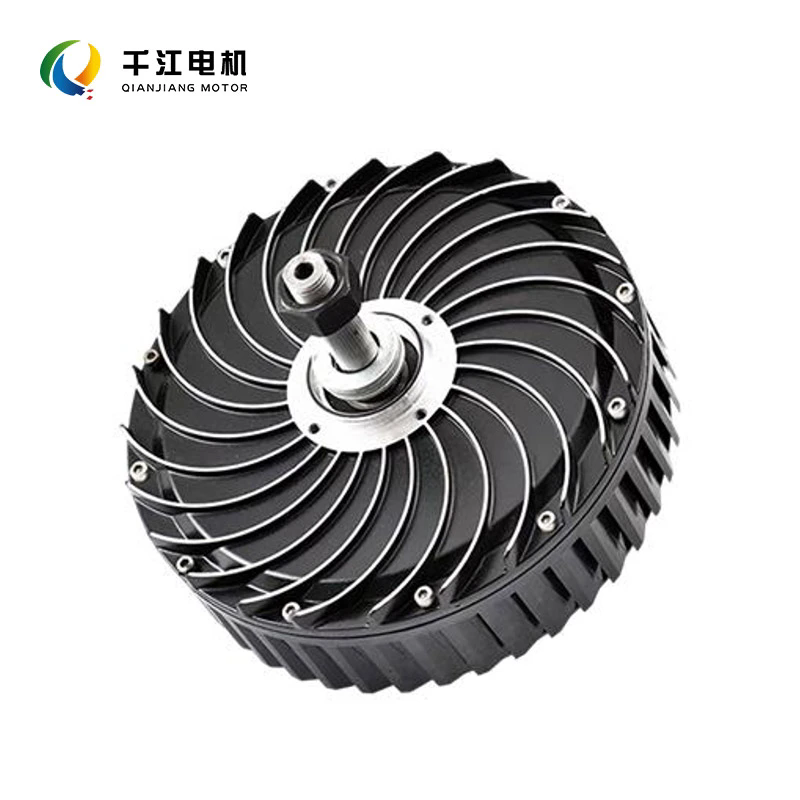
Table of Contents
- 1. What Is a Hub Motor and How Does It Work Without Gears?
- 2. What Design Features Enable High Efficiency in Gearless Hub Motors?
- 3. What Specifications Should Buyers Look For?
- 4. How Do You Match a Hub Motor to Your Vehicle Application?
- 5. How Do You Evaluate a Hub Motor Supplier?
- 6. What Are the Key Product Parameters from Our Factory?
- 7. Frequently Asked Questions (FAQ)
- 8. Conclusion
1. What Is a Hub Motor and How Does It Work Without Gears?
A Hub Motor is an electric motor that is integrated into the hub of a wheel. The stator, which contains the electromagnetic coils, is mounted on the axle. The rotor, which contains the permanent magnets, is attached to the wheel rim. When current flows through the stator coils, it creates a rotating magnetic field. This field interacts with the permanent magnets on the rotor, causing the rotor—and the wheel—to turn. There is no gearbox, no chain, and no belt. The motor drives the wheel directly. This is why Hub Motors are often called direct-drive motors. The absence of a gearbox eliminates the mechanical losses associated with gear meshing, which is one of the key reasons for their high efficiency.
The physics of a gearless Hub Motor is based on the principle of electromagnetic induction. The stator coils are energized in a specific sequence by the motor controller. This sequence creates a rotating magnetic field that interacts with the permanent magnets on the rotor. The interaction produces torque, which turns the rotor. The speed of the motor is determined by the frequency of the electrical commutation, which is controlled by the motor controller. The torque is determined by the current flowing through the coils. There is no gear reduction, so the motor runs at the same speed as the wheel. This means that the motor must be designed to produce high torque at low speeds, which is achieved through a large number of pole pairs and a high-strength magnetic circuit. The table below summarizes the key components of a gearless Hub Motor.
| Component | Function | Material |
| Stator | Contains coils that create rotating magnetic field | Laminated silicon steel, copper windings |
| Rotor | Contains permanent magnets that interact with field | Neodymium magnets, steel back iron |
| Axle | Supports stator and provides mounting | Hardened steel |
| Bearings | Allow rotor to spin freely | Sealed ball bearings |
| Controller | Regulates current and commutation | Electronic (external) |
| Hall Sensors | Detect rotor position for commutation | Semiconductor |
At Ningbo Qianjiang Motor Co., Ltd., our factory specializes in the design and manufacture of gearless Hub Motors for electric bicycles, scooters, and light electric vehicles. We have extensive experience in magnetic circuit design, thermal management, and controller integration. Our motors are used by leading OEMs and distributors around the world.
2. What Design Features Enable High Efficiency in Gearless Hub Motors?
The efficiency of a gearless Hub Motor is determined by several design features. The first is the magnetic circuit. The use of high-grade neodymium magnets and a laminated silicon steel stator reduces eddy current losses and hysteresis losses. The second is the winding design. The use of concentrated windings or distributed windings, depending on the application, reduces copper losses and improves the torque constant. The third is the air gap. A small, uniform air gap between the stator and the rotor maximizes the magnetic flux density and improves efficiency. The fourth is the thermal design. The motor must be able to dissipate the heat generated by the copper and iron losses. This is typically achieved through a combination of conduction to the axle and convection to the ambient air. The fifth is the controller. The controller must be matched to the motor to ensure that the commutation is efficient and that the current is regulated properly. The table below summarizes the design features that affect efficiency.
| Design Feature | Impact on Efficiency | Typical Value |
| Magnet Grade | Higher grade = higher flux = higher efficiency | N38 - N52 |
| Stator Lamination | Thinner laminations = lower eddy current losses | 0.35 mm silicon steel |
| Air Gap | Smaller gap = higher flux density | 0.5 - 1.0 mm |
| Winding Type | Concentrated winding = lower copper losses | Selected based on speed/torque |
| Thermal Design | Better heat dissipation = lower resistance | Aluminum housing, fins |
| Controller Matching | Proper commutation = lower switching losses | FOC or sine wave |
At our factory, we use advanced electromagnetic simulation software to optimize the magnetic circuit, the winding design, and the thermal management of our Hub Motors. We also use high-precision manufacturing processes to ensure that the air gap is uniform and the magnets are properly aligned. Our goal is to provide our customers with Hub Motors that deliver the highest possible efficiency for their specific application.
3. What Specifications Should Buyers Look For?
When purchasing a Hub Motor, the buyer must specify several key parameters. These parameters determine whether the motor will meet the performance requirements of the vehicle and whether it will fit the wheel. The most important specifications are the rated voltage, the rated power, the rated speed, the rated torque, the wheel size, the axle type, the brake type, and the connector type. The rated voltage determines the battery compatibility. The rated power determines the vehicle's performance. The rated speed determines the top speed. The rated torque determines the hill-climbing ability. The wheel size determines the fit with the tire and the frame. The axle type determines the mounting. The brake type determines the braking system compatibility. The connector type determines the controller compatibility. The table below summarizes these specifications and their importance.
| Specification | Typical Range | Importance for Vehicle Design |
| Rated Voltage | 24V, 36V, 48V, 60V, 72V | Determines battery compatibility |
| Rated Power | 250W - 3000W | Determines vehicle performance |
| Rated Speed | 200 - 500 rpm | Determines top speed |
| Rated Torque | 10 - 80 Nm | Determines hill-climbing ability |
| Wheel Size | 16" - 28" | Determines fit with tire and frame |
| Axle Type | Solid, Hollow, Quick Release | Determines mounting method |
| Brake Type | Disc, Drum, V-Brake, Roller Brake | Determines braking compatibility |
| Connector Type | Julet, Higo, Custom | Determines controller compatibility |
| Efficiency | 80% - 90% | Determines battery range |
At Qianjiang Motor, we help our customers specify the right Hub Motor for their vehicle. We can provide technical data sheets, performance curves, and integration support. Our goal is to make the specification process as straightforward as possible for our customers.
4. How Do You Match a Hub Motor to Your Vehicle Application?
Matching a Hub Motor to a vehicle application requires a systematic approach that considers the vehicle's weight, the desired performance, the terrain, and the battery capacity. The first step is to determine the required power. The power required depends on the total weight of the vehicle and the rider, the desired top speed, and the gradeability. As a general rule, a 250W motor is suitable for a light e-bike on flat terrain. A 500W motor is suitable for a heavier e-bike or a cargo bike. A 1000W motor or higher is suitable for a scooter or a high-performance e-bike. The second step is to determine the required torque. The torque required depends on the weight and the maximum gradient. A higher torque motor is needed for steep hills. The third step is to determine the wheel size. The wheel size must match the frame and the tire. The fourth step is to determine the battery voltage. The battery voltage must match the motor voltage. The table below provides a guide to matching Hub Motors to common vehicle applications.
| Vehicle Type | Typical Weight (kg) | Recommended Power (W) | Recommended Voltage (V) | Recommended Wheel Size |
| City E-Bike | 20 - 25 | 250 - 350 | 36 | 26" - 28" |
| Mountain E-Bike | 22 - 28 | 500 - 750 | 48 | 27.5" - 29" |
| Cargo E-Bike | 30 - 50 | 750 - 1000 | 48 - 52 | 20" - 26" |
| Electric Scooter | 15 - 30 | 500 - 1500 | 48 - 60 | 8" - 12" |
| Light Electric Vehicle | 100 - 300 | 2000 - 3000 | 60 - 72 | 10" - 14" |
At our factory, we work with our customers to match the Hub Motor to their specific vehicle application. We can provide performance calculations, simulation data, and prototype testing. Our goal is to ensure that the motor we supply meets the performance and reliability requirements of the vehicle.
5. How Do You Evaluate a Hub Motor Supplier?
Evaluating a supplier of Hub Motors is critical for ensuring a reliable supply of high-quality products. The key criteria for evaluating a supplier are manufacturing capability, quality management, engineering support, production capacity, delivery performance, and cost. Manufacturing capability includes the ability to wind stators, assemble rotors, and test motors. Quality management includes the systems and processes that ensure consistent quality. Engineering support includes the ability to assist with motor selection, controller matching, and integration. Production capacity includes the ability to meet large orders in a timely manner. Delivery performance includes the ability to meet lead times and to respond to urgent orders. Cost includes the total cost of ownership, not just the unit price. The table below summarizes these criteria and what to look for in each.
| Evaluation Criterion | What to Look For | Why It Matters |
| Manufacturing Capability | Winding machines, assembly lines, test equipment | Ensures product quality and consistency |
| Quality Management | ISO 9001 certification, inspection records | Ensures consistent product quality |
| Engineering Support | Motor design, controller matching, integration | Helps optimize motor for your application |
| Production Capacity | Monthly output, ability to scale | Ensures timely delivery of large orders |
| Delivery Performance | On-time delivery record, inventory capability | Keeps your production line running |
| Cost | Total cost of ownership, not just unit price | Ensures long-term value |
At Ningbo Qianjiang Motor Co., Ltd., our factory has been manufacturing Hub Motors for over a decade. We have a strong track record of quality, delivery, and customer satisfaction. We are ISO 9001 certified, and we maintain detailed records of all inspections. Our production capacity is among the largest in the region, and we can scale to meet large orders. Our engineering team is available to assist with motor selection and integration. We invite you to evaluate us against these criteria and to consider us as your partner for Hub Motors.
6. What Are the Key Product Parameters from Our Factory?
The following table provides the key product parameters for our gearless Hub Motors. These motors are designed for electric bicycles, scooters, and light electric vehicles and are available in a range of power ratings, voltages, and wheel sizes to suit different applications. Our factory can also produce custom motors to meet specific requirements.
| Parameter | Specification Range | Notes |
| Rated Voltage | 24V - 72V | Custom voltages available |
| Rated Power | 250W - 3000W | Custom power ratings available |
| Rated Speed | 200 - 500 rpm | Custom speeds available |
| Rated Torque | 10 - 80 Nm | Custom torque ratings available |
| Efficiency | 80% - 90% | Depends on speed and load |
| Wheel Size | 16" - 28" | Custom sizes available |
| Axle Type | Solid, Hollow, Quick Release | Custom axles available |
| Brake Type | Disc, Drum, V-Brake, Roller Brake | Custom brake options available |
| Connector Type | Julet, Higo, Custom | Custom connectors available |
| Ingress Protection | IP54, IP65 | IP65 for harsh environments |
| Operating Temperature | -20°C to +60°C | Custom temperature ranges available |
| Standards | EN 15194, CE, RoHS | Compliance with international standards |
At our factory, we manufacture our Hub Motors to meet these specifications and more. We can customize the voltage, power, speed, torque, wheel size, and connector to suit your specific requirements. Our quality control system includes inspection of raw materials, in-process inspection, and final inspection before shipment. Our goal is to provide our customers with high-quality Hub Motors that deliver reliable performance and long service life.
7. Frequently Asked Questions (FAQ)
Question 1: What is the difference between a gearless hub motor and a geared hub motor?
Answer: A gearless Hub Motor drives the wheel directly, with no internal gears. It is simpler, quieter, and more efficient at higher speeds, but it produces less torque at low speeds. A geared hub motor uses internal planetary gears to reduce the speed and increase the torque. It produces more torque at low speeds and is better for hill climbing, but it is more complex and noisier. The choice depends on the application. For flat terrain and higher speeds, a gearless Hub Motor is preferred. For hilly terrain and higher torque, a geared hub motor may be preferred.
Question 2: How do I choose the right power rating for my hub motor?
Answer: The right power rating depends on the vehicle weight, the desired top speed, and the terrain. As a general rule, a 250W motor is suitable for a light e-bike on flat terrain. A 500W motor is suitable for a heavier e-bike or a cargo bike. A 1000W motor or higher is suitable for a scooter or a high-performance e-bike. Our engineering team can help you calculate the required power for your specific application.
Question 3: Can a hub motor be repaired, or does it need to be replaced?
Answer: In many cases, a Hub Motor can be repaired. The most common repairs are replacing the bearings, the Hall sensors, or the controller. If the stator windings are damaged or the magnets are demagnetized, the repair may be more extensive. At Ningbo Qianjiang Motor Co., Ltd., we offer a full repair and reconditioning service for our Hub Motors. We can restore a motor to like-new condition at a fraction of the cost of a new motor.
Question 4: What is the typical efficiency of a gearless hub motor?
Answer: The typical efficiency of a gearless Hub Motor is 80% to 90%, depending on the speed and load. At low speeds, the efficiency is lower because the motor is operating at a low percentage of its rated speed. At higher speeds, the efficiency is higher. The efficiency is also affected by the controller, the battery voltage, and the ambient temperature. Our motors are designed to deliver high efficiency across a wide range of operating conditions.
Question 5: How do I maintain a hub motor?
Answer: Hub Motors require minimal maintenance. The most important maintenance tasks are keeping the motor clean and dry, checking the bearings for wear, and inspecting the wiring and connectors for damage. Avoid immersing the motor in water or using high-pressure washers, as this can force water into the motor. If the motor is used in a harsh environment, it should be inspected more frequently. Regular maintenance extends the life of the motor and ensures reliable performance.
8. Conclusion
Hub Motors deliver efficient power without gears by using direct-drive electromagnetic torque. The absence of a gearbox eliminates mechanical losses, reduces complexity, and improves reliability. For procurement engineers at e-bike and scooter manufacturers, selecting the right Hub Motor is a decision that affects vehicle performance, battery range, and customer satisfaction. By understanding the working principle, the design features that enable efficiency, the specifications to include in a purchase order, and the criteria for evaluating a supplier, buyers can make informed decisions that ensure they get the right motor for their application. At Ningbo Qianjiang Motor Co., Ltd., our factory has the expertise and the capacity to produce high-quality Hub Motors that meet the most demanding requirements. We use high-quality materials, precision manufacturing, and rigorous quality control to ensure that our motors deliver reliable performance and long service life.
Whether you are designing a new e-bike model, sourcing replacement motors for a fleet, or developing a light electric vehicle, we invite you to contact us to discuss your requirements. We can provide samples, technical data, and customized solutions. Our commitment to quality and customer satisfaction has made us a trusted partner for electric vehicle manufacturers around the world.
Contact Ningbo Qianjiang Motor Co., Ltd. today to discuss your Hub Motor requirements and discover how our gearless motors can improve the efficiency and performance of your electric vehicles.
Send Inquiry

X
We use cookies to offer you a better browsing experience, analyze site traffic and personalize content. By using this site, you agree to our use of cookies.
Privacy Policy