
Why Are Hub Motors the Mainstream Drive for Light Electric Vehicles?
Walk through any city in Asia or Europe, and you will see them: electric bicycles, e-scooters, and light electric vehicles gliding silently through traffic. Look closely at the rear wheel of an e-bike, and you will notice a compact, cylindrical housing integrated into the hub. That housing contains a Hub Motor, and its presence explains much of why light electric vehicles have become so popular. The Hub Motor is not just a component; it is the design decision that made the modern light electric vehicle possible. By integrating the motor directly into the wheel, manufacturers eliminated the need for chains, belts, and external gearboxes. The result is a simpler, lighter, and more reliable vehicle that is easier to manufacture and easier to maintain.
This guide is written for procurement managers, product developers, and engineers who are sourcing drivetrain components for light electric vehicles. We will explain why Hub Motors have become the mainstream drive, covering the design advantages, the performance characteristics, the trade-offs, and the criteria for selecting the right motor and supplier. We will also provide detailed product parameters from our factory at Ningbo Qianjiang Motor Co., Ltd. Whether you are developing an e-bike, an e-scooter, a wheelchair, or a light utility vehicle, this guide will help you understand why Hub Motors dominate this segment and how to choose the right one for your product.
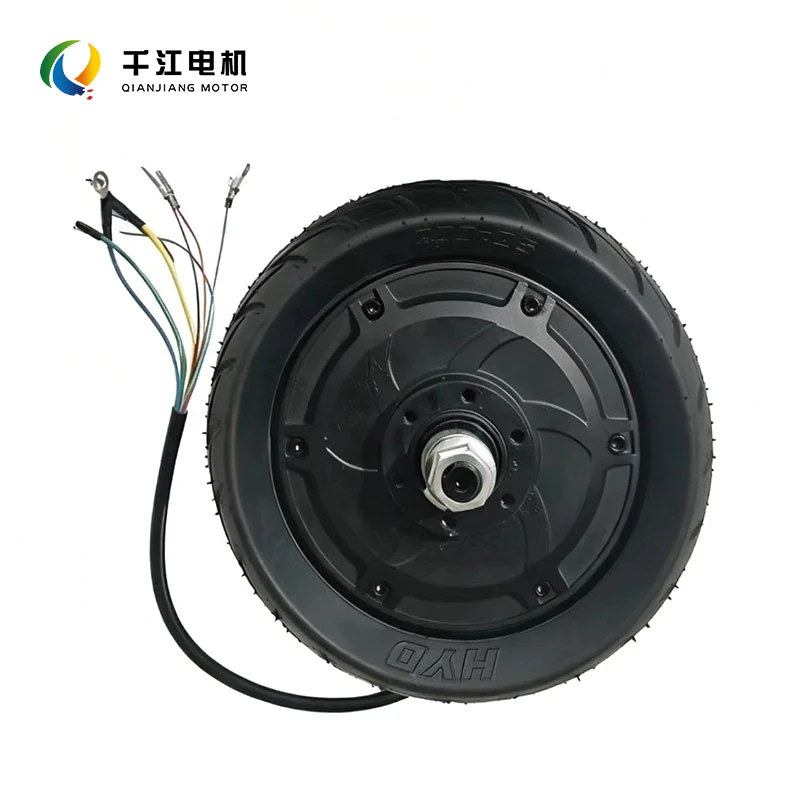
Table of Contents
- 1. What Is a Hub Motor and How Does It Fit into a Light Electric Vehicle?
- 2. Why Does the Integrated Design Reduce Complexity and Cost?
- 3. How Do Hub Motors Perform in Real-World Light Electric Vehicle Use?
- 4. What Are the Trade-Offs of Hub Motor Design?
- 5. How Do You Select the Right Hub Motor and Supplier?
- 6. What Are the Key Product Parameters from Our Factory?
- 7. Frequently Asked Questions (FAQ)
- 8. Conclusion
1. What Is a Hub Motor and How Does It Fit into a Light Electric Vehicle?
A Hub Motor is an electric motor that is built directly into the wheel hub of a vehicle. The stator, which contains the copper windings, is mounted on the axle. The rotor, which contains the permanent magnets, is attached to the wheel hub. When the motor is energized, the rotor turns the wheel directly. There is no gear reduction, no chain, no belt, and no external driveshaft. The motor is the wheel, and the wheel is the motor. This integration is the defining characteristic of the Hub Motor, and it is the reason why it has become the default choice for light electric vehicles. The table below summarizes the components of a typical Hub Motor assembly.
| Component | Function | Material |
| Stator | Houses the copper windings that generate the magnetic field | Laminated steel, copper |
| Rotor | Houses the permanent magnets that interact with the stator field | Steel, neodymium magnets |
| Axle | Supports the motor and attaches to the vehicle frame | Hardened steel |
| Bearings | Allow the rotor to spin smoothly | Sealed ball bearings |
| Hall Sensors | Provide position feedback to the controller | Semiconductor |
| Housing | Protects the internal components from dust and water | Aluminum alloy |
At Ningbo Qianjiang Motor Co., Ltd., our factory manufactures Hub Motors for a wide range of light electric vehicles. We produce both geared hub motors, which use an internal planetary gearset, and direct-drive hub motors, which have no gears. Each type has its own advantages, and the choice depends on the application. Our engineering team can help you select the right type for your vehicle.
2. Why Does the Integrated Design Reduce Complexity and Cost?
The integrated design of a Hub Motor reduces complexity and cost in several ways. First, it eliminates the need for a separate motor, gearbox, and drivetrain. In a conventional mid-drive system, the motor is mounted on the frame, and the power is transmitted to the rear wheel through a chain and derailleur. This requires a complex mounting system, a chain tensioner, and a freewheel mechanism. A Hub Motor eliminates all of these components. The motor is the wheel, and the only connection required is the electrical cable. Second, the integrated design reduces the number of parts that must be manufactured, assembled, and inventoried. A mid-drive system may have dozens of components. A Hub Motor system has a fraction of that number. This reduces both the bill of materials and the assembly time. The table below compares the component count of a Hub Motor system and a mid-drive system.
| Component | Hub Motor System | Mid-Drive System |
| Motor | 1 (integrated into hub) | 1 (frame-mounted) |
| Gearbox | 0 (direct drive) or 1 (internal) | 1 (integrated into motor) |
| Chain / Belt | 0 | 1 |
| Derailleur / Tensioner | 0 | 1 |
| Freewheel | 0 or 1 (in hub) | 1 (at crankset) |
| Mounting Brackets | 0 (axle mounts directly) | 2-3 |
| Total Major Components | 2-4 | 8-12 |
At our factory, we design our Hub Motors to be as integrated as possible. We use sealed connectors and waterproof cables to reduce the number of external connections. We also design the motor housing to be part of the wheel structure, eliminating the need for a separate wheel hub. This integration reduces weight, improves reliability, and simplifies assembly. Our customers appreciate the simplicity of the Hub Motor design, and it is one of the main reasons why Hub Motors have become the mainstream drive for light electric vehicles.
3. How Do Hub Motors Perform in Real-World Light Electric Vehicle Use?
The performance of a Hub Motor in real-world light electric vehicle use is shaped by its direct-drive nature and its integration into the wheel. On flat terrain and gentle slopes, a Hub Motor provides smooth, quiet, and efficient propulsion. The absence of a chain or belt eliminates the noise and maintenance associated with those components. The motor's direct connection to the wheel provides instant torque response, which is particularly useful in stop-and-go city traffic. The sealed housing protects the motor from dust and water, making it suitable for year-round use in a variety of climates. The table below summarizes the real-world performance characteristics of Hub Motors.
| Performance Aspect | Hub Motor Characteristic | Real-World Benefit |
| Acceleration | Instant torque response | Quick starts in traffic |
| Top Speed | Directly proportional to voltage and wheel size | Predictable performance |
| Hill Climbing | Moderate (requires larger motor for steep hills) | Adequate for most urban terrain |
| Noise | Very quiet (no gears or chain) | Pleasant riding experience |
| Maintenance | Minimal (sealed bearings, no lubrication) | Lower ownership cost |
| Weather Resistance | IP54 - IP67 | Reliable in rain and dust |
| Regenerative Braking | Supported on direct-drive models | Extended range, reduced brake wear |
At Ningbo Qianjiang Motor Co., Ltd., our factory tests our Hub Motors under real-world conditions to ensure that they meet the performance requirements of our customers. We test for acceleration, top speed, hill climbing, and weather resistance. We also test for durability, running our motors for thousands of hours to verify their long-term reliability. Our goal is to provide our customers with Hub Motors that perform consistently and reliably in the conditions they will encounter in the field.
4. What Are the Trade-Offs of Hub Motor Design?
While Hub Motors offer significant advantages, they also come with trade-offs that buyers should understand. The most significant trade-off is unsprung weight. Because the motor is integrated into the wheel, its weight is not supported by the vehicle's suspension. This can affect ride quality, especially on rough surfaces. The second trade-off is the lack of gear reduction. Direct-drive Hub Motors produce maximum torque at high speeds, but their torque at low speeds is limited. This can be a disadvantage on steep hills or when starting from a standstill with a heavy load. Geared Hub Motors address this by using an internal planetary gearset, but they introduce additional complexity and wear. The third trade-off is heat dissipation. Hub Motors are enclosed in a compact housing, which can make it difficult to dissipate heat during sustained high-power operation. The table below summarizes these trade-offs.
| Trade-Off | Cause | Effect | Mitigation |
| Unsprung Weight | Motor integrated into wheel | Reduced ride quality on rough surfaces | Use lightweight materials, suspension tuning |
| Low-Speed Torque | Direct-drive design | Limited hill-climbing ability | Use geared hub motor or larger motor |
| Heat Dissipation | Enclosed housing | Reduced continuous power | Use aluminum housing, thermal management |
| Wheel Size Limitation | Motor integrated into hub | Limited to certain wheel sizes | Select motor designed for wheel size |
At our factory, we work with our customers to mitigate these trade-offs. We use lightweight aluminum alloys for our motor housings to reduce unsprung weight. We offer geared Hub Motors for applications that require higher low-speed torque. And we design our motors with efficient thermal paths to maximize heat dissipation. Our goal is to provide Hub Motors that deliver the best possible balance of performance and practicality for each application.
5. How Do You Select the Right Hub Motor and Supplier?
Selecting the right Hub Motor and supplier requires a systematic evaluation of your vehicle's requirements and the supplier's capabilities. The key parameters to consider are the motor type (direct-drive or geared), the rated power, the rated voltage, the rated torque, the wheel size, the IP rating, and the mounting configuration. The supplier evaluation should consider manufacturing capability, quality control, testing, and technical support. The table below provides a selection guide for Hub Motors.
| Parameter | Typical Range | Importance |
| Motor Type | Direct-Drive, Geared | Determines torque, speed, and wear characteristics |
| Rated Power | 250 W - 3,000 W | Determines speed and hill-climbing ability |
| Rated Voltage | 24 V - 72 V | Must match battery and controller |
| Rated Torque | 10 Nm - 100 Nm | Determines acceleration and load capacity |
| Wheel Size | 8" - 28" | Must match vehicle design |
| IP Rating | IP54 - IP67 | Determines environmental protection |
| Mounting | Front, Rear, Cassette | Must match frame design |
| Brake Type | Disc, Drum, V-Brake, Regenerative | Must match braking system |
At Ningbo Qianjiang Motor Co., Ltd., our factory has the expertise and the equipment to manufacture Hub Motors that meet the most demanding requirements. We are ISO 9001 certified, and we maintain detailed records of all inspections. Our technical team is available to assist with selection and application engineering. We invite you to evaluate us against these criteria and to consider us as your partner for Hub Motors.
6. What Are the Key Product Parameters from Our Factory?
The following table provides the key product parameters for our Hub Motors. These motors are designed for e-bikes, e-scooters, wheelchairs, and light electric vehicles. Our factory can also produce custom Hub Motors to meet specific requirements.
| Parameter | Specification Range | Notes |
| Motor Type | Direct-Drive, Geared | Selected for application |
| Rated Power | 250 W - 3,000 W | Custom power ratings available |
| Rated Voltage | 24 V - 72 V | Selected for battery compatibility |
| Rated Torque | 10 Nm - 100 Nm | Selected for load and acceleration |
| Rated Speed | 200 - 1,500 rpm | Selected for top speed |
| Wheel Size | 8" - 28" | Custom sizes available |
| IP Rating | IP54 - IP67 | Selected for environment |
| Efficiency | 80% - 90% | Depends on speed and load |
| Expected Life | 10,000 - 20,000 hours | Depends on operating conditions |
| MOQ | 100 pieces | Negotiable for large orders |
| Lead Time | 2 - 4 weeks | Depends on quantity and customization |
At our factory, we manufacture our Hub Motors to meet these specifications and more. We can customize the motor type, power, voltage, torque, speed, wheel size, and IP rating to suit your specific requirements. Our quality control system includes inspection of raw materials, in-process inspection, and final inspection before shipment. Our goal is to provide our customers with high-quality Hub Motors that offer reliable performance and long service life.
7. Frequently Asked Questions (FAQ)
Question 1: Why are hub motors more common than mid-drive motors in light electric vehicles?
Answer: Hub Motors are more common because they are simpler, lighter, and less expensive to manufacture. They integrate the motor directly into the wheel, eliminating the need for a chain, belt, or external gearbox. This reduces the number of components, simplifies assembly, and lowers maintenance requirements. Mid-drive motors offer better weight distribution and hill-climbing performance, but they are more complex and more expensive. For most light electric vehicles, the Hub Motor offers the best balance of cost, simplicity, and performance.
Question 2: What is the difference between a geared hub motor and a direct-drive hub motor?
Answer: A geared Hub Motor uses an internal planetary gearset to reduce the motor's speed and increase its torque. This provides better hill-climbing performance and a smaller, lighter motor. However, the gears introduce additional wear and noise. A direct-drive Hub Motor has no gears, so it is quieter and more durable, but it is larger and has lower torque at low speeds. The choice depends on the application's requirements for torque, weight, and maintenance.
Question 3: Can hub motors be used on cargo bikes or heavy-duty light electric vehicles?
Answer: Yes, Hub Motors can be used on cargo bikes and heavy-duty light electric vehicles, but they must be sized appropriately. A larger, more powerful motor is required to handle the additional weight and load. Geared Hub Motors are often preferred for heavy-duty applications because they provide higher torque at low speeds. At Ningbo Qianjiang Motor Co., Ltd., we offer high-torque Hub Motors for cargo and utility vehicles.
Question 4: How do I choose between a front hub motor and a rear hub motor?
Answer: The choice between front and rear Hub Motors depends on the vehicle design and the desired handling characteristics. A front Hub Motor provides better traction on slippery surfaces because the weight of the motor is over the front wheel. However, it can affect steering feel. A rear Hub Motor provides better acceleration and hill-climbing performance because the weight is over the rear wheel. It also leaves the front wheel free for suspension and steering. Most light electric vehicles use rear Hub Motors.
Question 5: What is the typical warranty for a hub motor?
Answer: The typical warranty for a Hub Motor is 1 to 2 years, depending on the manufacturer and the application. The warranty covers defects in materials and workmanship. It does not cover damage from accidents, misuse, or normal wear. At Ningbo Qianjiang Motor Co., Ltd., we offer a 2-year warranty on our Hub Motors for light electric vehicle applications. We also provide after-sales support and spare parts.
8. Conclusion
Hub Motors have become the mainstream drive for light electric vehicles because they offer a combination of simplicity, cost-effectiveness, and reliability that is difficult to match with other drivetrain architectures. By integrating the motor directly into the wheel, they eliminate the need for chains, belts, and external gearboxes. This reduces the number of components, simplifies assembly, and lowers maintenance requirements. While Hub Motors have trade-offs, such as unsprung weight and limited low-speed torque, these can be mitigated through careful design and material selection. At Ningbo Qianjiang Motor Co., Ltd., our factory has the expertise and the equipment to manufacture high-quality Hub Motors for a wide range of light electric vehicles. We use advanced manufacturing processes and rigorous testing to ensure that our motors deliver reliable performance and long service life.
Whether you are developing an e-bike, an e-scooter, a wheelchair, or a light utility vehicle, we invite you to contact us to discuss your requirements. We can provide samples, technical data, and customized solutions. Our commitment to quality and customer satisfaction has made us a trusted partner for businesses around the world.
Contact Ningbo Qianjiang Motor Co., Ltd. today to discuss your Hub Motor requirements and discover how our motors can power your light electric vehicle.
Send Inquiry

X
We use cookies to offer you a better browsing experience, analyze site traffic and personalize content. By using this site, you agree to our use of cookies.
Privacy Policy